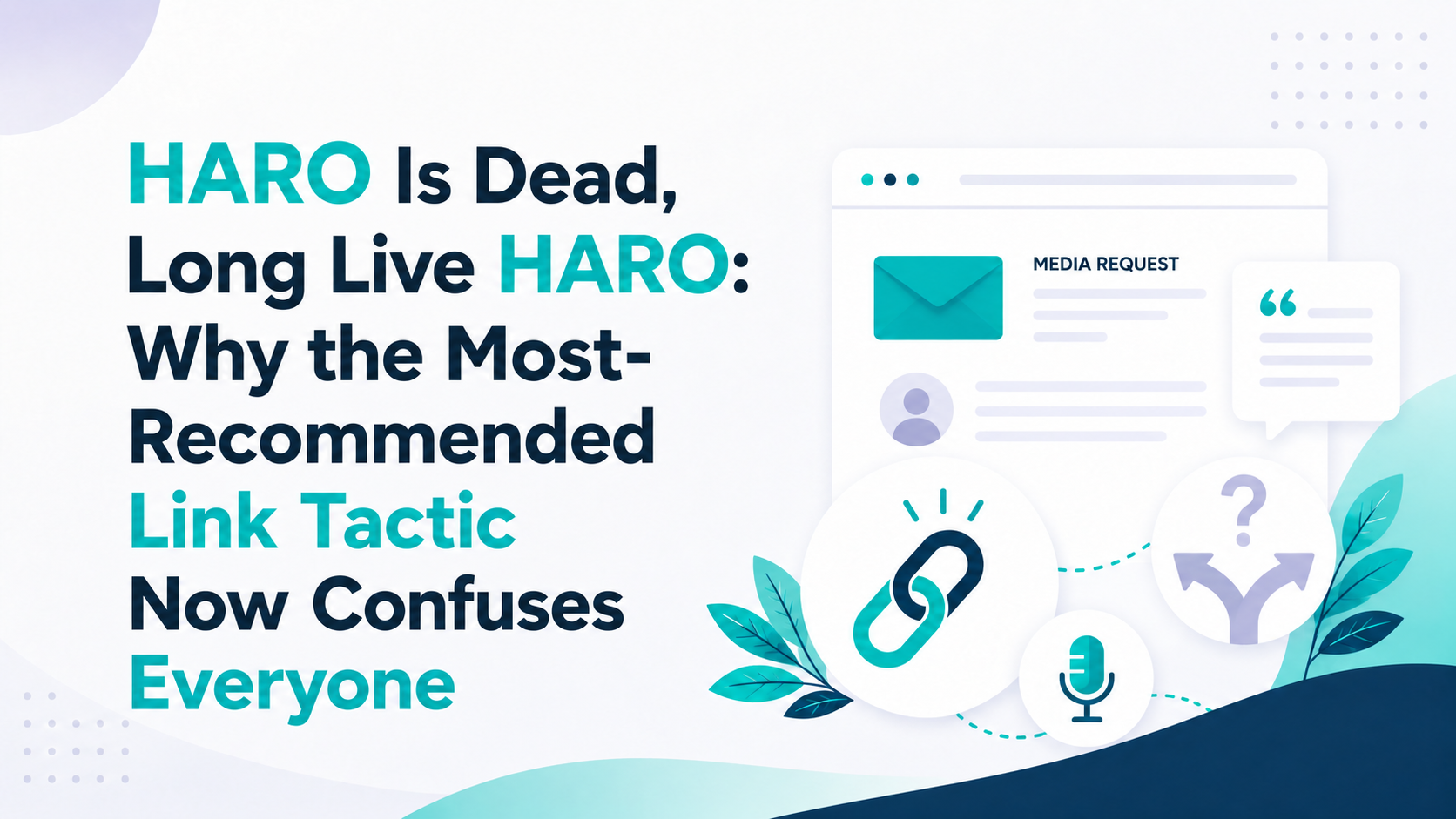
Ask almost any SEO to name a genuinely white-hat link tactic and ‘HARO’ will be one of the first words out of their mouth. Help A Reporter Out — the service that connects journalists needing sources with experts willing to be quoted — has been the go-to answer for years, because a journalist choosing to quote you and cite your site is exactly the kind of genuine editorial endorsement Google actually wants to count. There’s just one problem in 2026: almost nobody can tell you what HARO actually is anymore. The service was shut down, sold, relaunched, and then partially rebranded into three different products with three different names — and the vast majority of guides online still describe a version that no longer exists. The most-recommended link tactic in the industry has become the one people are most confused about. Here’s the honest, current map, and why the confusion is quietly good news for anyone willing to understand it.
What Actually Happened To HARO
The confusion is understandable, because the last two years genuinely have been a mess of ownership changes and rebrands. Here’s the sequence in plain terms. HARO ran for years as the industry-standard platform, latterly under the Connectively brand, owned by Cision. Then Cision shut it down at the end of 2024, retiring the Connectively platform the whole industry had built its workflows around. That looked, for a moment, like the end of HARO entirely.
It wasn’t. The HARO name was sold, and the service relaunched — free — in 2025. Then things got more confusing again in 2026, when the new owner revived the old Connectively brand as a separate platform product. The upshot is that ‘HARO’ today isn’t one thing; it’s a name that’s survived a death and two rebrands, which is exactly why the guides contradict each other. Anyone reading advice written before these changes is being told to use a platform that has since changed hands, changed shape, or changed name.
The Three Brands, Three Jobs Map
The single most useful thing to understand in 2026 is that what used to be one platform is now effectively three distinct things, each doing a different job. Get this straight and the whole picture clears up.
HARO: The Free Newsletter
The HARO name now lives on as the free newsletter — the classic format where journalist queries land in your inbox and you respond to the relevant ones. For most people, this is still the entry point and still free, which is exactly where a newcomer should start. If you remember HARO as ‘the email full of journalist requests,’ that version essentially still exists under the HARO name.
Connectively: The Platform
Connectively — confusingly, the same name Cision used before shutting it down — has been revived as the platform product: the web-based interface for managing queries and pitches, as opposed to the plain newsletter. So the same brand name now points at something different from what it meant a couple of years ago, which is a large part of why old guides mislead. When a 2026 source says Connectively, it means the platform, not the defunct Cision version.
Featured: The AI PR Layer
Featured is the third piece — positioned as an AI-assisted PR tool spanning journalist requests, podcasts, bylines and more. It’s the most feature-rich and the most commercial of the three. The key point for clarity: HARO, Connectively and Featured are best understood as three tiers of the same underlying idea — free newsletter, platform, AI PR suite — rather than three competitors. Knowing which one a guide is talking about is the difference between following current advice and following a ghost.
Why The Tactic Still Works — Whatever It’s Called
Step back from the branding chaos and the underlying tactic is exactly as strong as it ever was, because what makes it work has nothing to do with the name on the platform. The mechanism is unchanged: a journalist, exercising their own editorial judgement, chooses to quote you and cite your site in a publication with real editorial standards.
That’s the gold standard of a white-hat link. It’s the opposite of a self-placed link — you didn’t choose it, a journalist did, which is precisely why search engines value it and why it carries genuine authority. On top of the link itself come brand exposure, referral traffic, and real credibility signals. This is the same principle that makes all genuine editorial guest posting valuable — an editorial gatekeeper deciding your contribution is worth publishing — applied through journalists instead of blog editors. The tactic earns the real article; the confusing part is only which door you walk through to reach it.
Why The Confusion Is Actually Good News
Here’s the counterintuitive upside. When a tactic is confusing, fewer people use it well — and in link building, a tactic that fewer people execute properly is a less crowded, more valuable opportunity for those who do.
The rebrand chaos raised the barrier to entry: casual operators reading outdated guides give up or use the wrong tool, while the fragmentation into specialised platforms actually reduced the saturation that made HARO harder to win on in its crowded heyday. So the very confusion that makes the tactic annoying to understand is also keeping it uncrowded for the people who take ten minutes to learn the current map. That’s a recurring pattern in genuinely white-hat tactics, and it’s the same reason broken link building stays effective — the tactics that take a little real effort to understand and execute are the ones that stay worth doing, precisely because most people won’t.
How To Actually Use It In 2026
Cutting through the noise, here’s the practical approach:
- Start with the free HARO newsletter. It’s still free and still the simplest entry point. Get journalist queries in your inbox and respond to the ones where you have genuine expertise — before paying for any platform.
- Ignore any guide that predates the changes. If a source tells you to ‘set up your Featured profile’ as though it’s the whole story, or describes Connectively as the old Cision platform, it’s out of date. Check the date before you trust the advice.
- Respond with real value, fast. Journalists work to deadlines and want genuine, quotable expertise or data. A prompt, specific, actually-useful response wins the placement; a generic one gets ignored. This is expertise-led, not volume-led.
- Don’t chase only followed links. Publications set their own link policy, so you’re not guaranteed a followed link — but a mention in a genuine publication carries brand and authority value regardless. Judge the placement, not just the link attribute.
The Bottom Line
HARO isn’t dead — it died, got sold, relaunched free, and then split into three brands doing three jobs, which is why almost every guide online now describes a version that no longer exists. The current map is simple once you have it: HARO is the free newsletter, Connectively is the platform, and Featured is the AI PR layer, all reaching the same prize — a journalist-placed editorial link, the kind Google genuinely counts. The tactic works for exactly the reason it always did, and the branding chaos is quietly keeping it uncrowded for anyone willing to learn the current setup. Understand the map, start with the free newsletter, respond with real expertise, and it remains one of the most genuinely white-hat links you can earn. If you’d rather build that kind of genuine authority across several tactics at once, white hat link building packages combine journalist-earned links with the other methods that share the same principle — and every approach behind white hat SEO backlinks rests on the same idea: earn the link an editor or journalist actually chose to give.