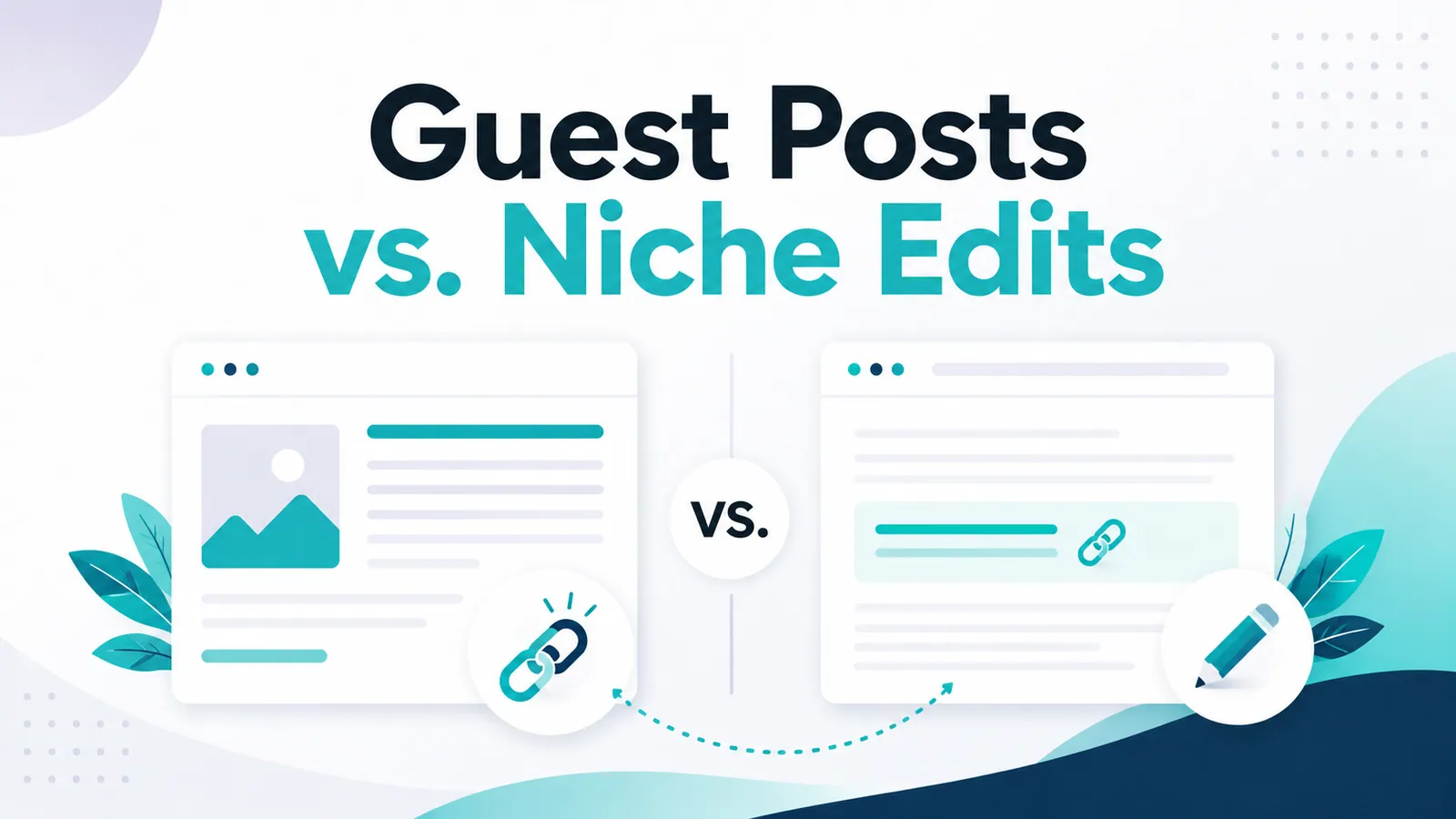
Guest posts and niche edits are the two workhorses of white hat link building, and the debate over which is better never really ends. The honest answer is that it depends on your site, your niche, and your goals — which is exactly why the most valuable thing you can do isn't read another opinion piece, but run a small, controlled test on your own domain. This guide explains how to do that properly, and what patterns tend to emerge when people do.
First, a clear definition of each
A guest post is a brand-new article you place on another site, written around your link. Because the page is created fresh, you control the topic, the surrounding content, and the context your link sits in. The trade-off is that a new page starts with zero accumulated authority and no existing traffic — it has to earn those over time.
A niche edit, sometimes called a link insertion, is a link added into an article that already exists on a site. The advantage is that you're inserting your link into a page that may already have age, indexing, traffic, and its own backlinks. The trade-off is that you don't control the page's creation, and the fit between your link and the existing content has to be genuinely relevant rather than shoehorned in.
Why you should test rather than trust a blanket claim
Anyone who tells you one format universally beats the other is overselling. The effect of a link depends on the strength of the host page, the relevance to your topic, the anchor used, and the competitiveness of the keyword you're chasing. A weak guest post on a fresh page can underperform a strong niche edit on an established, relevant article — and the reverse is just as common. The only profile that truly matters is your own, so the sensible move is to gather evidence from your own site instead of importing someone else's conclusion.
How to design a test that actually tells you something
The core principle is to change one variable at a time. If you build a guest post and a niche edit at the same time, but they point at different pages, use different anchors, and sit on sites of wildly different quality, you'll learn nothing — too many things moved at once.
Start by selecting target pages of comparable difficulty. Ideally pick two of your pages chasing keywords of similar competitiveness and similar starting positions, so neither has an unfair head start. Then hold the link characteristics as constant as you reasonably can: similar host-site authority, similar topical relevance, and the same style of anchor text on both. The goal is for the format — guest post versus niche edit — to be as close to the only difference as possible.
Next, record a clean baseline before anything goes live. Note each target page's current ranking position for its keyword, its existing impressions and clicks, and the date. Without a documented before, you can't credibly measure the after.
Be patient and measure the right things
The most common mistake is judging too early. Links take time to be discovered, indexed, and factored in, and ranking movements are noisy in the short term. Give the test a realistic window — typically a couple of months at minimum — before drawing any conclusion. Checking obsessively after a week will only feed you noise.
When you do measure, look beyond a single ranking number. Track the trend in position over several weeks rather than a one-day snapshot, watch impressions and clicks in your search console data, and note how quickly each link was indexed in the first place. A link that gets indexed fast and lifts impressions steadily is doing its job, even if the headline ranking hasn't jumped yet.
What the data usually shows
While every site is different, some patterns recur often enough to be worth flagging. Niche edits frequently show their effect faster, because the host page is already indexed and trusted, so the link starts passing signals sooner. Guest posts often start slower but can deliver durable value, because you control the relevance and context so tightly, and a well-placed contextual link on a topically aligned new page ages well.
Relevance tends to matter more than format. A highly relevant link of either type usually outperforms a less relevant link of the other. And host-page strength is a heavy thumb on the scale — a link from a genuinely authoritative, trafficked page beats a link from a weak one almost regardless of whether it arrived as a guest post or an edit. In practice, the sites that get the best results rarely pick a side; they use both, matching the format to the situation.
Turning your test into a strategy
Once you've run a couple of honest tests, you'll start to see which format moves the needle for your particular niche and competition level. Use that to weight your ongoing link building rather than to declare a permanent winner. If niche edits consistently get you faster traction in your space, lean on them for pages that need momentum. If guest posts give you more durable, relevant placements, use them to build the long-term foundation. The point of testing isn't to crown a champion once and forget it — it's to keep making decisions based on what your own data tells you, which is the most white hat approach to link building there is.