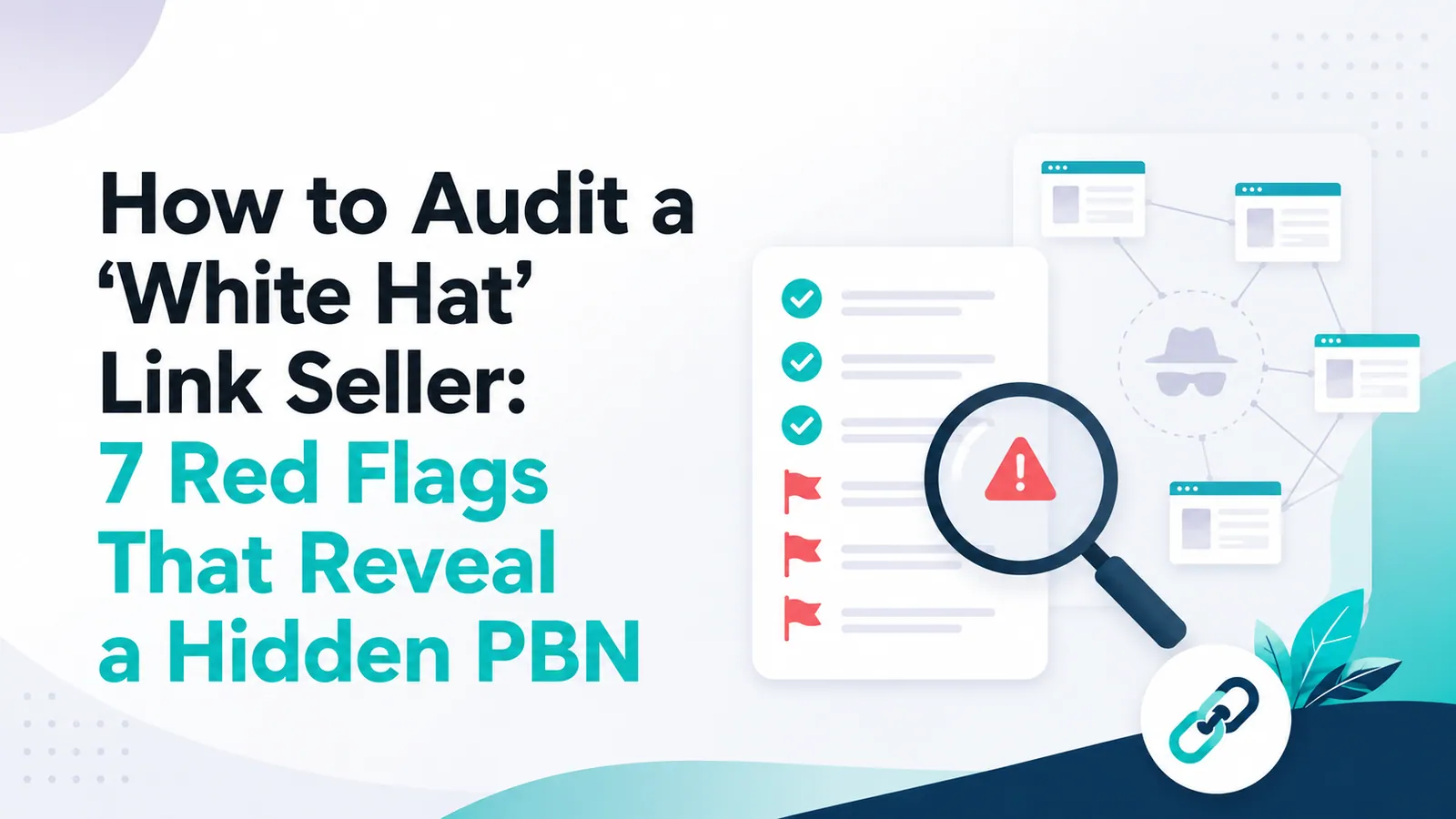
Ask ten link vendors whether they're "100% white hat" and ten will say yes. The phrase has been repeated so often that it's lost most of its meaning. What actually separates a legitimate provider from one quietly placing your money into a private blog network (PBN) isn't the marketing copy — it's a handful of signals you can check yourself in about twenty minutes.
This guide walks through the red flags I look for in white hat link building when assessing whether a link source is genuinely editorial or a recycled network wearing a clean shirt. None of this requires premium tooling; most of it requires nothing more than a browser, a free backlink checker, and a healthy amount of skepticism.
Why a hidden PBN is your problem, not theirs
When a vendor places a link on a site they secretly control, you inherit the risk while they keep the margin. PBNs are built to look like independent publishers, but search engines have spent over a decade fingerprinting the footprints they leave behind. If the network gets deindexed, every link you bought from it can evaporate overnight — and in the worst cases, the pattern of links pointing at your site becomes its own liability. The vendor loses one customer. You lose rankings you may have spent months building.
That asymmetry is exactly why vetting matters. You're not being paranoid; you're refusing to outsource your risk assessment to the person being paid.
Red flag 1: The site has traffic from nowhere
A genuine publisher attracts organic visitors. Run any proposed link site through a traffic estimator and look at the trend line. A real blog shows a messy, human-looking curve — seasonal dips, gradual growth, the occasional viral spike. A PBN frequently shows a flat line near zero, or a strange pattern where the domain ranks for a scattering of unrelated keywords that don't match its supposed topic. If a "finance blog" pulls its only visibility from queries about pet grooming and discount sneakers, the domain was almost certainly bought at auction for its leftover authority rather than built for an audience.
Red flag 2: An expired-domain history
The cheapest way to spin up a fake publisher is to buy a domain that already had links pointing at it, then rebuild a site on top of those links. Check the domain's history. A site that claims to have been "publishing since 2015" but whose archived snapshots show a law firm, then a parked page, then a sudden pivot to your exact niche is waving a giant flag. Sudden topical reinvention with no editorial continuity is one of the most reliable PBN tells there is.
Red flag 3: A thin, templated content library
Open the blog and actually read three posts. Network sites tend to publish content that exists only to host links: generic, lightly spun, and oddly uniform in length and structure. Look for author bios that are stock photos, comment sections that have never seen a real human, and a publishing cadence that goes from dormant to a burst of ten posts in one week and back to silence. Real publications have a pulse. Filler factories have a heartbeat monitor flatlining between invoices.
Red flag 4: An outbound link profile that makes no sense
This is the big one. On a legitimate site, outbound links point to relevant, reputable sources because the writer is genuinely referencing them. On a PBN, the outbound links are the product, so they tend to point at a grab-bag of unrelated commercial sites: a casino here, a supplement store there, a local plumber, a crypto exchange. If one "lifestyle blog" is linking out to a dozen wildly different industries with hard commercial anchors, you're looking at a link farm, not a publication.
Red flag 5: The vendor won't show you the site before you pay
Plenty of network operators hide their inventory precisely because the footprint becomes obvious the moment you can inspect it side by side. There are legitimate reasons a vendor protects a premium placement list, but "you'll find out which site after payment clears" is a structure that benefits only them. A confident, genuinely editorial provider of niche edit links can usually show you metrics, a sample, or at least the category and traffic profile of where your link will live.
Red flag 6: Hosting and technical fingerprints
This one takes a little more effort but it's decisive. PBNs are expensive to diversify, so operators cut corners on infrastructure. Sites in the same network often share hosting ranges, the same handful of nameservers, identical theme-and-plugin stacks, recycled analytics or AdSense IDs, and near-identical site structures. If you can inspect two "unrelated" placement sites and find they're technical twins, they're siblings.
Red flag 7: Prices that don't match the claimed authority
Genuine editorial placements on real publications cost real money, because a real editor's time and reputation are on the line. When a vendor offers links on sites with impressive authority metrics at suspiciously low prices, ask why the economics work. Often the answer is that the "authority" is a metric inflated by the very network the link lives in, and the low price reflects the near-zero marginal cost of publishing on a site you already own.
A 20-minute vetting routine you can reuse
Pulling it together, here's the rhythm I'd suggest for any placement you're considering. Start by checking the domain's traffic trend and the keywords it ranks for. Then look at its history for an unexplained topic change. Read three posts to judge whether a real human audience is being served. Scan the outbound links for a coherent, relevant pattern. Finally, ask the vendor direct questions about where the link lives and how they price it, and pay attention to how comfortable they are answering.
No single flag is a conviction. Real sites occasionally have quirks, and a slow blog isn't automatically a network. But when three or four of these signals stack up on the same domain, the pattern is rarely a coincidence. The goal isn't to become paranoid about every link — it's to make sure that when you pay for "white hat," you're buying placements on sites that would still exist and still have value even if you'd never sent a penny.